AI and Human Digitization
The age of immersive technologies has created a growing need for processing detailed visual representations of ourselves as virtual and augmented reality is growing into the next generation platform for online communication. A natural simulation of our presence in such virtual world is unthinkable without a photorealistic 3D digitization of ourselves. In visual effects and gaming, compelling CG characters can already be produced using state-of-the-art 3D capture technologies combined with the latest real-time rendering engines. However, the creation of high-quality digital assets are still bounded by expensive and time-consuming production pipelines, and creating photorealistic results still requires authoring tasks that can only be achieved by skilled digital artists.
This seminar will open up the question in whether a deep learning-based synthesis approach could potentially displace conventional graphics rendering pipelines, as well as promote awareness of modern technology’s capability to manipulate videos, at a time in which social media is susceptible to the spread of doctored videos and fake news.
Venue: EG02 Lecture Theatre, E Block, Ground Floor, UNSW Art & Design, Cnr Oxford Street & Greens Road, Paddington, NSW 2021
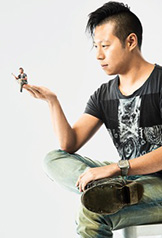
Hao Li
CEO/Co-Founder of Pinscreen, A/Prof of University of Southern California, Director of the Vision and Graphics Lab (USC Institute for Creative Technologies)Hao's work in Computer Graphics and Computer Vision focuses on digitising humans and capturing their performances for immersive communication and telepresence in virtual worlds. His research involves the development of novel geometry processing, data-driven, and deep learning algorithms. He is known for his seminal work in non-rigid shape alignment, real-time facial performance capture, hair digitisation, and dynamic full body capture. He was previously a visiting professor at Weta Digital, a research lead at Industrial Light & Magic / Lucasfilm, and a postdoctoral fellow at Columbia and Princeton Universities. He was named top 35 innovator under 35 by MIT Technology Review in 2013 and was also awarded the Google Faculty Award, the Okawa Foundation Research Grant, as well as the Andrew and Erna Viterbi Early Career Chair. He won the Office of Naval Research (ONR) Young Investigator Award in 2018. Hao obtained his PhD at ETH Zurich and his MSc at the University of Karlsruhe (TH).