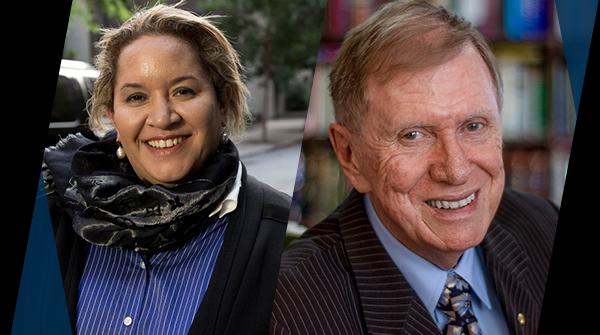
Dialogue of the Titans - Megan Davis & Michael Kirby
A dialogue between two extraordinary human rights defenders on holding a United Nations Human Rights Mandate.
Since the foundation of the UN in 1945, human rights leaders have worked with the United Nations throughout the world ‘to reaffirm faith in fundamental human rights, in the dignity and worth of the human person, in the equal rights of men and women and of nations large and small’
But what is the reality of working with the UN? And what is it possible to achieve for human rights given the nature of global politics?
Join us for an open and frank discussion on the experience (and sometimes frustrations) of working with the UN, with Law Professor Megan Davis in conversation with former High Court Justice Michael Kirby about their respective UN human rights mandates. With recent work on Indigenous Human Rights, access to essential medicine and in North Korea, there will be plenty to discuss.
Megan Davis
Professor Megan Davis is Pro Vice-Chancellor Indigenous UNSW and a Professor of Law, UNSW Law. Professor Davis was elected by the UN Human Rights Council to UNEMRIP in 2017. Professor Davis currently serves as a United Nations expert with the UN Human Rights Council's Expert Mechanism on the rights of Indigenous peoples based in UN Geneva. Megan is an Acting Commissioner of the NSW Land and Environment Court. Professor Davis is a Fellow of the Australian Academy of Law and a Fellow of the Australian Academy of Social Sciences. She is a member of the NSW Sentencing Council and an Australian Rugby League Commissioner. Professor Davis was Director of the Indigenous Law Centre, UNSW Law from 2006-2016.
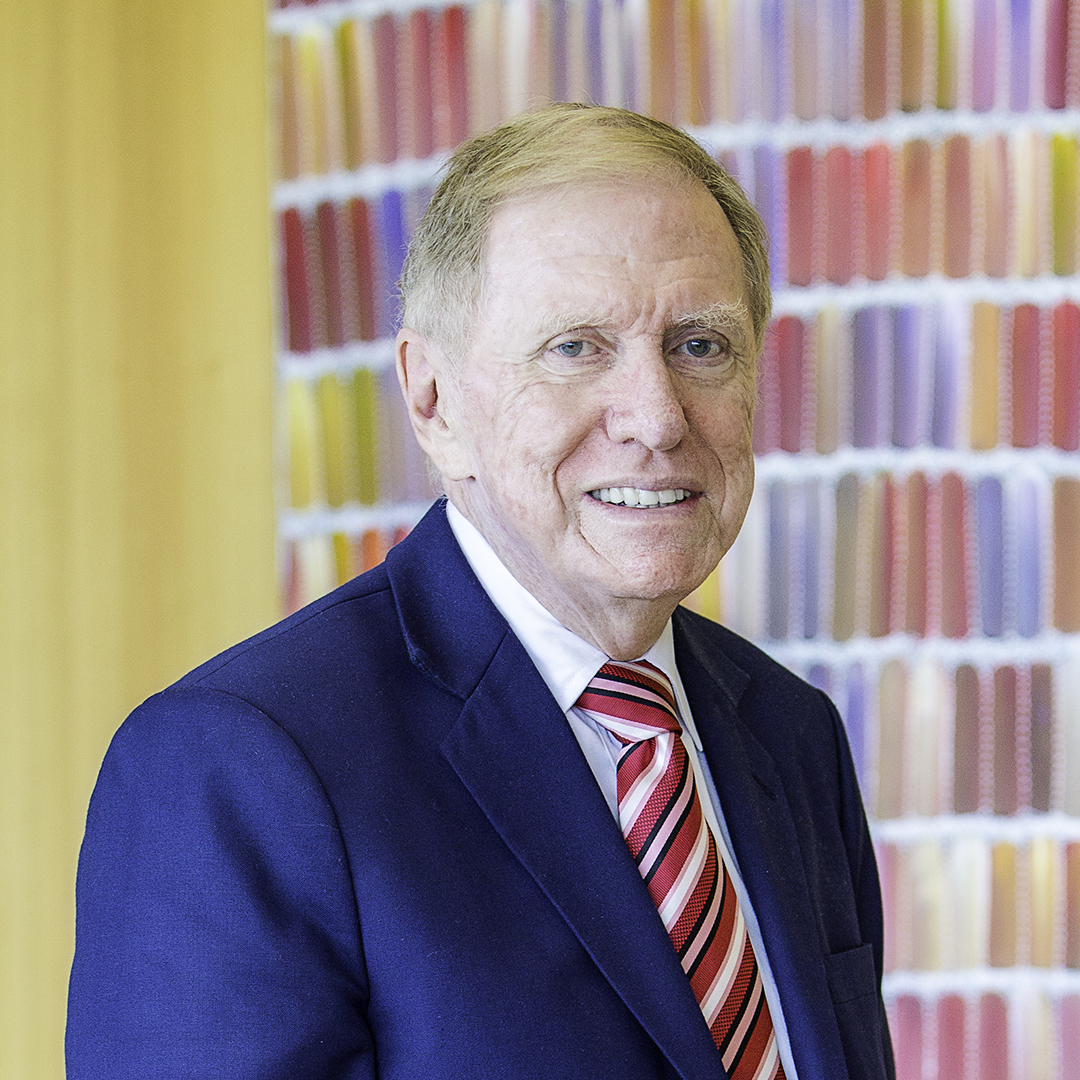
Michael Kirby
Michael Kirby is a highly distinguished Australian jurist and legal scholar who served as a Justice of the High Court of Australia from 1996 to 2009. He has been recognised internationally for his contributions to human rights and social justice and is affectionately known as the ‘Great Dissenter’ for his well-reasoned, independent, and sometimes controversial opinions.
He was a member of the World Health Organisation’s Global Commission on AIDS and since retiring from the High Court, has continued his work in various international roles, including as a Commissioner on the UNDP Global Commission on HIV and the Law, and as a member of the UNAIDS Reference Group on HIV and Human Rights. He has been awarded the Australian Human Rights Medal, was named a laureate of the UNESCO Prize for Human Rights Education and received the Gruber Justice Prize for his work on sexual orientation discrimination and international human rights law, including laws relating to privacy and HIV/AIDS. He is also a public speaker, commentator, and author.